Saturday, October 16, 2010

3rd Annual National Wildlife Refuge Week Kids Fishing Clinic a Success!!

For the third year in a row, I have partnered with the Panther/10,000 Islands National Wildlife Refuges and Port of the Islands Marina to host a kids fishing clinic in honor of National Wildlife Refuge Week. Each year we invite students from Collier County's Migrant Student Program to attend, and I can say hands down, they are the best kids to work with!! I don't know who has more fun-them our us! We had 48 kids participate in this year's clinic, and the weather couldn't have been better!!
The students rotate through a series of skills stations before getting to fish along the marina's seawall. The kids did an awesome job fishing. They caught tarpon, snappers, and mojarras! Then half the group has lunch while the other half goes on a manatee tour and then they switch.
The event is a great example of team work. Collier County Parks and Recreationa dontates shrimp, the Marco Island Sport Fishing Club sends volunteers, FWC sends an officer, and the refuge sends staff and volunteers to teach the skills stations, Port of the Islands Marina donates the lunch (pizza), Double R's Manatee and Nature Tours donates the manatee tours, and Fish Florida donates the rod and reels and tackle boxes that the kids get to keep and take home-one of many highlights of the day! I can't thank our partners, volunteers, and sponsors enough! Enjoy the pictures


Friday, October 15, 2010

The 2010 Stone Crab Season is Open!!!

(taken from a FDACS press release)

FLORIDA STONE CRAB SEASON OPENS TODAY

Fresh Florida stone crab claws will soon be back in seafood markets and restaurants across the Sunshine State. Stone crab season opens today and runs through mid-May. The fishery is closed for five months each year to help protect and sustain Florida's valuable stone crab resource.
Stone crab, Menippa adina and Menippa mercenaria and their hybrids, inhabit bays and estuaries along the Atlantic and Gulf coasts. An adult stone crab is easily recognized by its oval-shaped body and two large claws. The body is dark brownish red with dusky gray spots. The large claws have shiny black tips and are used by the crab for hunting and for defending itself. A crab can intentionally drop a claw if the claw is damaged or if the crab is trying to escape from a predator. The claw will eventually grow back, getting larger each time the crab molts.
The stone crab's ability to regenerate lost limbs makes it possible to harvest the meaty claws without killing the crab. Florida law forbids the harvesting of whole stone crabs. Instead, fishermen remove one or both claws and return the live crab to the water, where it can regenerate its lost limbs in about 18 months. Claws must be at least 2-3/4 inches long to be harvested legally, and claws may not be taken from egg-bearing females. Claws must be removed carefully, at just the right spot, in order for regeneration to take place.
"The special way Florida stone crab claws are harvested helps assure the long-term sustainability of these species," Florida Agriculture Commissioner Charles H. Bronson said. "This seafood delicacy that has been a Florida favorite for generations will continue to be enjoyed long into the future."
Stone crabs are caught using baited traps. Though stone crabs can be found as far north as North Carolina and as far west as Texas, stone crab claws are commercially harvested almost entirely in Florida. The majority are harvested off the southern tip of the peninsula from Sarasota to Fort Lauderdale. In 2009 the top three stone crab-harvesting counties were Monroe, Collier, and Citrus. Stone crab is one of Florida's top commercial seafood products in terms of dockside value. Ranking second behind shrimp, Florida's stone crab harvest was worth close to $18 million last season.
Stone crab claws are cooked in boiling water immediately after harvest, on the boat or at dockside, to prevent the meat from sticking to the inside of the shell. Claws are sold fresh-cooked or frozen. They come in several size grades based on weight: medium (up to 3 ounces), large (between 3 and 5 ounces), and jumbo (5 ounces and up). It generally takes about a pound of crab claws to feed one person.
Stone crab claws are usually served in the shell. One of the most popular ways to serve them is cold on a bed of ice with a mustard dipping sauce, but they are also commonly eaten hot with drawn butter and lime juice. The firm, sweet meat tastes similar to lobster. It's extra lean, low in fat, and a good source of protein.
Fresh-cooked stone crab claws should have a mild sea-breeze aroma. Store them at 32 degrees Fahrenheit in the coldest part of the refrigerator and be sure to use them within two days of purchase. Stone crab claws without cracks in the shell can be frozen for up to six months. Thaw frozen claws in the refrigerator for 12 to 18 hours. Thawing them in running water or at room temperature will negatively affect the taste and texture.
To crack the shell, use a crab cracker (a tool available at kitchen supply shops and department stores) or the back of a heavy spoon. Remove the cracked shell pieces, leaving the meat attached to the moveable pincer. The meat can also be picked from the claws and used in soups, stews, and other dishes. Approximately 2-1/2 pounds of cooked stone crab claws yield 1 pound of meat.

Florida Stone Crab Recipes

Curried Stone Crab Claws with Hot Marmalade Sauce:
http://www.fl-seafood.com/recipes/seafood-4135.htm

Stone Crab Claws Miami:
http://www.fl-seafood.com/recipes/seafood-4200.htm


Marinated Stone Crab Claws:
http://www.fl-seafood.com/recipes/seafood-4201.htm

Honey Citrus Florida Stone Crab Claws with Hearts of Palm Salad:
http://www.fl-seafood.com/recipes/seafood-4245.htm

Stone Crab Claws with Spicy Golden Mustard Sauce:
http://www.fl-seafood.com/recipes/seafood-4246.htm

Mango Marinated Stone Crab Claws:
http://www.fl-seafood.com/recipes/seafood-4253.htm

Wednesday, October 13, 2010

Recording of Stone Crab Fishery Webinar

Today, as part of my "Brown Bag" webinar* series I delivered a presentation on Florida's stone crab fishery. The purpose of the presentation was to increase participants knowledge about basic stone crab biology and ecology, enhance their understanding of one of Florida's most valuable commercial fisheries, and make participants more informed consumers regarding Florida's seafood products. If you click on the link below you will be able to view a recording of the webinar. The program I use is called Elluminate Live so before you click on the recording below make sure your computer is compatiable with the program.

Please ensure you are able to connect by first going to http://www.elluminate.com/support/index.jsp and working through steps 1 and 2. If you have connection problems, please contact Ron Thomas with UF/IFAS distance education (http://icsde.ifas.ufl.edu/) (rkthomas@ufl.edu) to sort them out.


(You might get a message that blocks you from downloading the webinar; yout have to click on "allow" to let your computer to download the presentation)


*A webinar is a free presentation, lecture, workshop or seminar that is transmitted over the internet. This new media platform allows you to interact with the presenter and the content. To join a webinar, you will need the 30 to 90- minutes and access to a computer with internal or external speakers

Tuesday, October 12, 2010

Panhandle Outdoors, Oil Spill Special Edition: A Great Resource!

I know this blog is suppose to focus on my Extension work here in Collier County, but I wanted to share with you a great resource some of my Sea Grant and UF Extension Colleagues have put together regarding the Gulf Oil Spill. The "Panhandle Outdoors" is a newsletter put together by the UF Extension Agents in Florida's Northwest districit, which encomposes the Panhandle region. These agents have done an outstanding job working with their local communities to address a variety of  issues associated with the oil spill and the newsletter highlights their work and topics of concern. If you get a scond, please check them out. I have thoroughly enjoyed reading them and have learned a lot myself!

Summer Edition
The articles in this issue provide a place to start and cover a variety of topics including a basic introduction to oil spills, clean-up and response methods, seafood safety, human stress, and environmental impacts.
http://lyra.ifas.ufl.edu/LyraServlet?command=getNewsletter&soid=PanhandleOutdoorsMay-August2010&countyID=nwdistrict.ifas.ufl.edu

Fall Edition:
The oil spill is “over” and the clean-up is winding down.  The economic and environmental impacts however, will likely last much longer.  The Fall issue of Panhandle Outdoors takes another look at the immediate response to the spill and its impacts, and then turns an eye to the future and continued recovery
http://lyra.ifas.ufl.edu//LyraServlet?command=getNewsletter&soid=PanhandleOutdoorsSeptember-December2010&countyID=nwdistrict.ifas.ufl.edu

Sunday, October 10, 2010

Stone Crab Season is Around the Corner!

In 5 days seafood lovers will be able to get fresh stone crab claws as the season officially opens October 15th. This of course, doesn't mean the stone crab fishermen haven't been busy. For the past several weeks, they have been making last minute repairs to their vessels and old traps, contstructing new traps, and taking inventory of their their gear and supplies. Stone crabs are one of Florida's most valuable commercial fisheries in the state. In 2009 2.6 million claws were landed with an estimated value of $17 million.
Collier County, in particular, is recognized as one of the leading commercial harvesters in Florida second only to Monroe County. In 2009 approximately 639,646 pounds of claws were landed in the county with an estimated dockside value of $4.2 million.
The commercial stone crab fishery is managed by a seven month open season (October 15-May 15), minimum claw size requirement (2 3/4 inches), trap specifications, and a passive trap limitation program. Female crabs with eggs are also prohibited from being harvested.
The fact that only the claws are taken and the crab is not killed helps ensure the long-term sustainability of the fishery. Fishing pressure, however, remains high and this is reflected by a general decreasing trend in catch-per-trap over time. For example between the 1962-63 and 2001-02 seasons the number of traps used in the fishery increased 100 fold from 15,000 traps to 1.6 million traps (In 2002 the state legislature implemented a trap limitation program to reduce the number of trap entering the fishery). Estimates for stone crab population distribution, abundance, and recruitment patterns, however, have remained steady for the past 20 to 30 years.

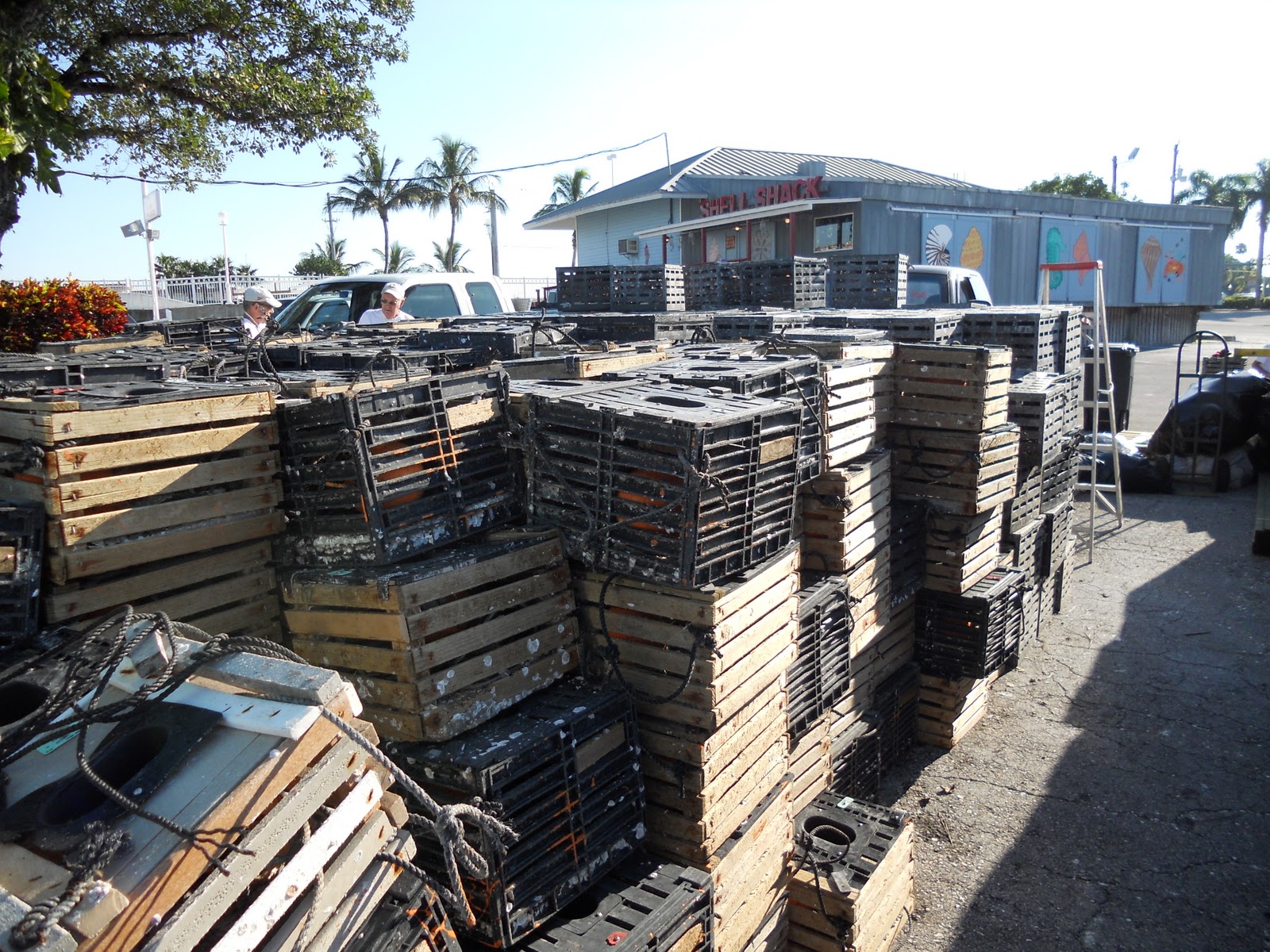
Stone crabs are harvested primarily using baited traps. Commonly used bait included pig's feet, mullet, and/or fish carcasses. Traps are typically constructed of wood or plastic, but wire traps are also allowed. Plastic traps are required to have a degradable wood panel to minimize bycatch if the trap is lost or abandoned. Traps are deployed in long lines of up to 100 traps where each individual trap is buoyed. A single operation may have thousands of traps in the water at a time though. Trap buoys (and vessels) are marked with the letter "X" and a permit number specific to each harvester and every trap must have a valid permit tag attached to it. Fishermen may only work their traps during daylight hours and traps are retrieved approximately every 10 to 12 days using a mechanical winch. It is important to remember that it is a third degree felony for tampering with someone else’s traps (or their content), lines, or buoys. In addition to criminal penalties, violators can be fined $5,000 and lose their saltwater fishing privileges.

Friday, October 8, 2010

Just Because Its Small Doesn't Mean Its Bait!!

Recently I helped an FWC officer identify some juvenile permit he confiscated from anglers who were using them as bait (To be exact, he confiscated over 50 of the fish!). Permit, of course, is a popular sport fish that is regulated by both a slot size and bag limit.

Catching bait is a common practice among many anglers. In fact, you normally don't have to look too far to find someone throwing a cast net from shore or a boat to catch their bait. We're fortunate in Florida to have a wide variety of species that can be used as baitfish, but it’s important to remember that just because a fish is small, it doesn't mean its legal bait! Not all juvenile sportfish look exactly like their adult form and can be confused with commonly used baitfish.
Unfortunately, on more than one occasion I've seen anglers keep everything they land in their net despite having juvenile sport fish among the catch. I see this happen most often with juvenile permit and pompano which can be found along our beaches and juvenile lane snappers that can be found in many locations. Even if it is unintentional, anglers can face fines (possibly per fish) and potentially jail time if caught in possession of these regulated fish. Of course from a conservation perspective, it would not make sense to keep and use these fish either as we want them to mature and reach legal size.
As a responsible angler it is important to not only be aware of and follow the fishing regulations, but to also be aware of what juveniles sport fish look like so that they don't accidentally end up as bait. Below are some examples of juvenile sportfish you might encounter if you catch bait either along the beach or estuaries. To view the current saltwater fishing regulations visit:
 http://pub.jfgriffin.com/doc/jfgriffin/10FLSWJUL


mangrove snapper

sheepshead

Spotted sea trout

Pompano
Permit

Lane snapper


                                                                   Snook


Tuesday, October 5, 2010

Aquatic Species Educator Collection Permit Workshop, Gainesville!

seining is a great way to collect specimens!
This week I'm up in Gainesville for our annual Florida Sea Grant Extension meeting. It an opportunity for my colleagues and I to recap what we've done this past year and begin planning for the next. Last night my colleagues Dr. Maia Mcguire and Chris Verlinde who are also Sea Grant Extension Agents, and I hosted an Aquatic Species Educators Collection Permit Workshop for local school teachers as well as some of our other Sea Grant Agents who don't have the permit yet. We certified 11 educators at the workshop, who should get their collecting permits in the next 4 to 6 weeks!
The aquatic species collection permit is offered through FWC  and the Florida Marine Science Educators Association and is an excellent opportunity to Florida educators to collect and possess aquatic species for their classrooms or programs.

The workshop is available to certified Florida teachers and/or employees of educational centers. Certificate holders are eligible to collect specified aquatic species for educational purposes that would be restricted under fishing license guidelines. This Educator Certification is valid for 3 years.
During the training workshop, participants discuss collecting alternatives, benefits, collection and transport techniques, methods to minimize environmental impact, restrictions imposed by the Collecting Certificate, available resources, and related activities. Its also a great opportunity to meet and network with other educators!!!

 If you have questions about future workshops, give me a call. At the moment, I do not have any scheduled, but am keeping a list of interestered educators for the next one.