Tuesday, November 2, 2010

Florida Master Naturalist Program Underway!

Yesterday, I began teaching the coastal module of the Florida Master Naturalist Program. I am team teaching the course with my colleagues from Rookery Bay, and we have a very enthusiastic group this time around. I look forward to getting to know the participants. As much as I hope I teach them, I always learn something from them as well.
 After introductions, paperwork, and a course overview we covered basic interpretation techniques and general coastal ecology. The class is meeting Mondays and Wednesdays until Nov 22. Keep a look out for future pictures from the class!
FMNP students listen to Rookery Bay Environmental
Specialist Sarah Falkowski about interpretation techniques

Friday, October 29, 2010

Hodges University Seafood Course a Success

Students enjoy sampling local seafood as I play a game
with them called "Who's Smarter than a Stone Crab?" The
purpose of the activity was to teach them about Florida's
Stone Crab fishery
Yesterday I finished up teaching a 3-part class on seafood safety and sustainability for Hodges University's Center for Lifelong Learning Program. Fourteen people attended the course. I delivered several presentations relating to seafood including:
  • Gulf Seafood Safety in light of the Oil Spill
  • Balancing the Health Benefits and Risks of Seafood
  • Seafood Supply and Demand and Sustainability Issues
  • Proper Seafood Handling for the Consumer
  • Florida's Stone Crab Fishery
Participants received plenty of handouts relating to these topics, and also had the opportunity to sample examples of seafood from South Florida including stone crab, blue crab, and pink shrimp. Captain Kirk's Seafood in Naples gave me a discounted price so that I could provide my students with the samples. Needless to say, the seafood was a huge hit! Several of the participants had never tried stone or blue crabs. Initial responses from the participants have been overly positive. As a result of the feedback, I plan to teach a similar class this winter. Keep a look out for announcements!

Thursday, October 28, 2010

NOAA Announces Action Agenda for Recreational Saltwater Fisheries

  For all you recreational fishermen out there, I thought you'd find this of interest.


(Source: NOAA Press Release)
 NOAA has released the Recreational Saltwater Fisheries Action Agenda, a national plan to address the complex issues facing marine recreational fisheries. The plan will improve science and stewardship and build a stronger partnership with the recreational community. It is a direct outcome of input received from recreational fishermen during the April 2010 Recreational Saltwater Fishing Summit organized by NOAA.


The Action Agenda includes a set of broad national goals, while focusing immediate attention on five priority issues:
  1. ensuring balanced recreational representation in the management process;
  2. more fully integrating recreational fishing values into the NOAA mission and culture;
  3. improving data on recreational fishing and fisheries;
  4. addressing recreational interests in NOAA’s catch share policy;
  5. supporting cooperative research and monitoring.
“The Action Agenda is the roadmap for us to fulfill our commitments made during NOAA’s Recreational Fishing Summit,” said Eric Schwaab, NOAA assistant administrator for the National Marine Fisheries Service. “We know it is the strength of our actions that matter in the end, and we are committed to moving forward aggressively.”

Schwaab also announced that NOAA will provide a $276,000 grant to the Atlantic States Marine Fisheries Commission to help give recreational fishermen conservation information. A portion of the national grant will support a collaborative workshop in spring 2011 to examine how best to reduce barotrauma – the injury to deepwater fish when pulled to the surface rapidly – in recreational fisheries, in order to improve survival of fish caught and then released.

“The resulting mortality due to barotrauma is a contentious issue among stakeholders,” said John V. O’Shea, executive director of the Atlantic States Marine Fisheries Commission. “The workshop will provide recreational fishermen, scientists, and managers the opportunity to develop a common understanding and approach to address this important issue.”

“Collaboratively, the recreational fishing community is a leading player in this program that will introduce stewardship to new anglers and reinforce the stewardship of existing anglers to reduce mortality of caught and released fish,” said Andy Loftus, coordinator for the Atlantic States Marine Fisheries Commission project. “The workshop will develop the best information available on catch-and-release practices that will be communicated to anglers for implementation. It’s a win-win in the best tradition of the recreational angling community and NOAA

Monday, October 25, 2010

The First Annual Naples Stone Crab Festival

This weekend I participated in the First Annual Naples Stone Crab Festival. I set up a booth by Kelly's Fish House. Beside a display and fact sheets I created on stone crabs and the fishery, I also had plenty of recipes and nutritional information about other types of Florida seafood. In addition, I had a tank with live stone crabs in it. My booth was a big hit. In all, approximately 500 people visited the booth during the two day event. I partnered with FWC law enforcement, who also helped educate visitors about stone crabs and other fisheries-related information. People seemed to be very appreciative of the information and materials we provided. I was amazed how little people knew about stone crabs despite loving to eat them. For example, a lot of people didn't realize that only the crab's claws are harvested and that the crab is returned to the water alive. In addition, they didn't know that if both of the crab's claws are legal size (2 3/4 inches), they can be harvested. Of course the next logical question was if the claws can grow back. Yes, it takes a crab approximately a year to regenerate and up to 3 years to regain 95% of the origin size. The festival seemed to be a huge success, and I look forward to participating in it next year. It was also a great opportunity for me to work with our local fishing industry and build a stronger work relationship with them.
visitors got their share of stone crabs during the festival

Workers from Kelly's Fish House stayed busy during the event

Despite long lines, they never ran out of claws!

Florida Master Naturalist Alumni Trip to Cayo Costa State Park

On Friday I lead of a group of Florida Master Naturalist Alumni to the beautiful barrier island state park, Cayo Costa! We couldn't have asked for better weather. Park Ranger Mary Olson gave us a tour of the island via golf cart, which was unique in itself. If you have never been to the park, I highly reccomend it. You can't ask for a better example of a pristine barrier island. You can only get to the island by boat. We took a ferry from Pine Island. The day was a great lesson in barrier island ecology. We drove through tropical hardwood hammock, pine flatwoods, coastal scrub, and of course saw the islands amazing dune and beach habitats as well. We also had the opportunity to pull a seine net on the lagoon side; we caught a sea robin, lizardfish, mojarra, scaled sardine, sheepshead minnow, goldspotted killifish, bay anchovie and blue crab. Unfortunately, I had to take the early ferry back because I wasn't feeling so great, but it was still a wonderful day. Enjoy the pictures.


There use to be a quarantine station on the north end of the island

look out to Boca Grand Pass

Ranger Mary tells the group about some endemic plants
to the island

There is a cool cemetary on the island with head stones
from the 1800's

Driving through some coastal habitats

This is the lagoon where we did our seining

Tuesday, October 19, 2010

Stone Crabber for a Day

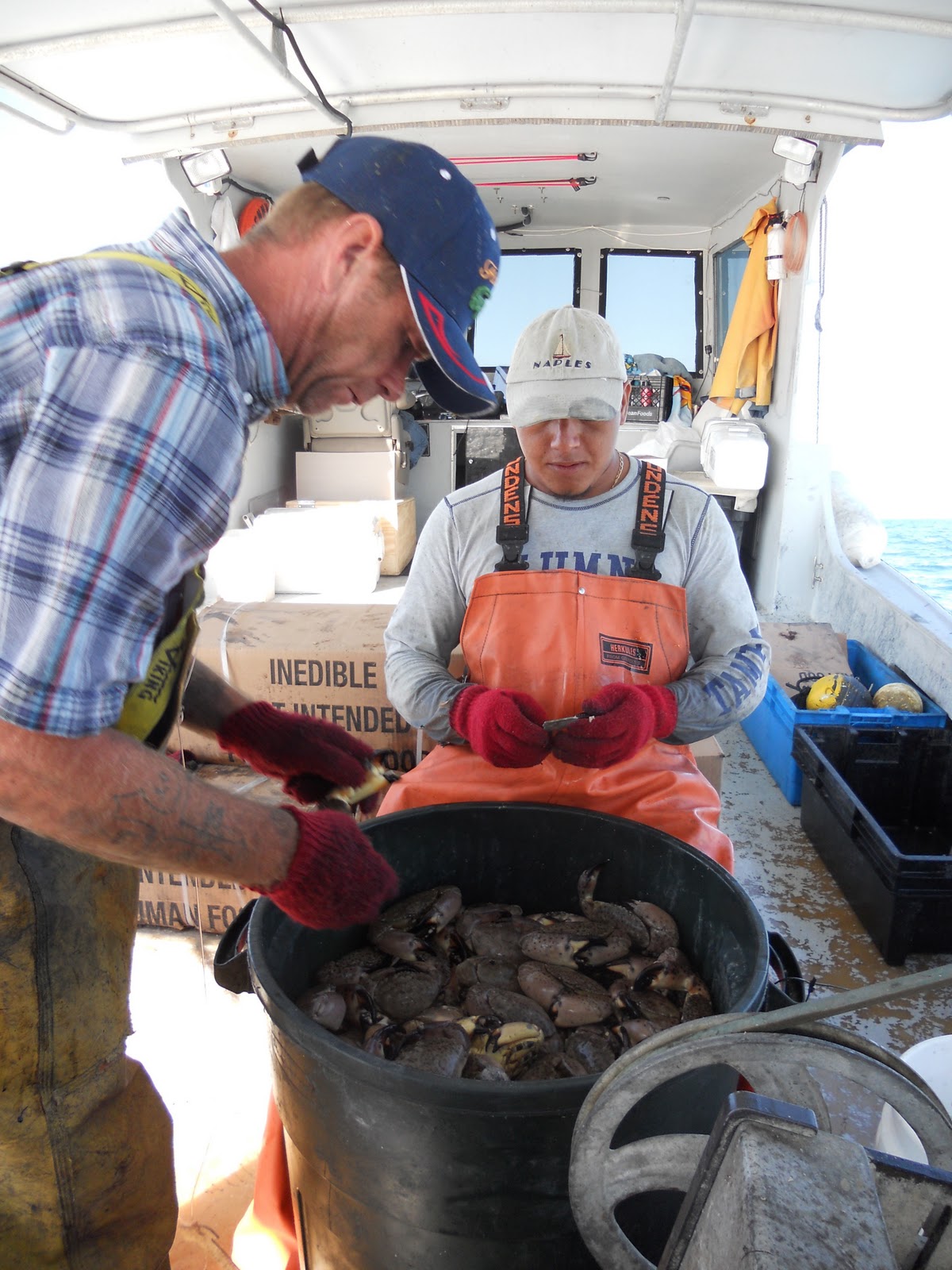
Yesterday I was privileged to be able to go out with Captain Ricky Mayfield, a local commercial stone crabber and his crew to see first hand what a typical day on the water is like for these guys. I already knew they put in long hours, but being able to help pull, bait, and deploy traps along side them only deepened my respect for them and the industry. It was a great learning experience for me. In all we pulled about 400 traps. Although I thought this was a lot, I was informed that this was considered a "slow day". (Well, my back says otherwise-I can't argue that I didn't get a heck of workout though!). By the end of the day we ended up bringing back close to 200 pounds of claws (again, this is considered a low). If there was anything I learned from yesterday's experience, it was the crew was all about working smart and efficient. It took all I had to keep up with them. It is a good thing they didn't solely depend on me to declaw the crabs or else we'd still be on the boat! I took plenty of pictures for you to get a better idea of what it was like. By the way, if you dine at Kelly's Fish House in Naples in the next several days, you might just eat some of the claws I helped catch!!! Enjoy!

If you'd like to learn more about stone crabs and the fishery visit:


On the water by 6:30AM. Note the trays
of hogs feet, which will be used as bait

Part of the mornings catch!


Stu cooling off the crabs until their claws are
removed and they're put back in the water.

An undersized crab in the a trap with
a piece of bait

Captain Ricky at the helm


Stu and Roberto declawing the crabs and
using a gauge to make sure the claws meet the
2 3/4 inch min size limit

Stu with a "hog" crab

Captain Ricky and Roberto unloading the day's catch

Weighing part of the day's catch back at
Combs Fish House