Saturday, January 7, 2012

New Article Sheds Light on Goliath Grouper in the Gulf of Mexico

Goliath grouper continue to be a hot topic in Southwest Florida as the debate of whether or not the fishery should be reopened in some capacity continues. Many anglers feel goliath grouper have completely recovered since the fishery was closed more than 20 years ago, and in fact have become nuisance species. Critical to this argument, though, is the importance of solid research to support any future management decisions that could make this change happen. Because the fishery has been closed for so long traditional fishery-dependent data (i.e. landings) have not been available to help managers  study their populations and estimate recovery efforts. Instead, managers have had to rely on directed fishery independent research efforts.

 A new article published by researchers with the Florida Fish and Wildlife Conservation Commission's Fish and Wildlife Research Institute helps shed new light on goliath grouper in the Gulf of Mexico. The paper titled, "Behavior, Habitat, and Abundance of the Goliath Grouper, Epinephelus itajara, in the Central Eastern Gulf of Mexico" describes the results of joint research effort between divers and scientists to explore goliath grouper distribution and abundance along the central west coast of Florida between October 2007 and May 2010. The project's aim was to address how goliath grouper presence, abundance and size distribution are related to habitat, depth and season.
Below are some of the highlights from the project:

  •  Goliath grouper were observed during all months of the year and were present during 74% of all surveys (280/378).
  • Presence and abundance were significantly related to habitat type and depth, with highest presence and abundance recorded over deep, artificial reefs.
  • The maximum number of goliath grouper observed during a single survey ranged from 0 to 24.
  • The mean number observed per site over artificial reefs was 4.53 versus 0.45 over natural habitat.
  • The number of fish observed over artificial habitats tended to increase with site depth and site size.
  •  Individual sites tended to hold approximately the same number of individuals throughout the year.
  • There was not a significant seasonal effect on abundance or presence; however, the highest numbers of individuals were observed during the summer months.
  • Goliath grouper were measured via underwater videography, and ranged in size from 40 – 205 cm total length (TL). The majority of individuals observed were between 100 -150 cm TL; however, multiple small (< 100 cm) and large (> 150 cm) individuals were also observed throughout the depth range surveyed.
  •  A total of 172 goliath grouper were fitted with external identification tags, and 27 individuals were resighted or recaptured throughout the study period. Time at large ranged 1 – 713 days. The majority of resighted individuals were observed at the same site as their initial tagging, although fish were documented to move as far as 203 km.
To view the entire article visit: 
 http://myfwc.com/media/1767222/CRP-goliath.pdf.
 
If you'd like to learn more about goliath grouper research efforts, visit:
FWC-FWRI
 
Florida State University

Wednesday, January 4, 2012

Staying Legal Between the Lines with Mangrove Snapper


Grey or Mangrove snapper are one of the most sought after recreational fish in southwest Florida. They will take a variety of baits, are good eating, and are relatively easy to catch even for novice anglers. In addition, they can be found in virtually all coastal and offshore habitats from mangroves (as their name implies) out to natural ledges and artificial reefs in deeper waters. Because of their versatility, anglers often target these popular fish in both state and federal waters of the Gulf of Mexico.

While many Gulf species have the same fishing regulations for state and federal waters, this is not the case for mangrove snapper. For Florida state waters, which extend out to nine nautical miles in the Gulf, the minimum size limit is 10 inches total length with a daily bag limit of five fish per angler. In Gulf federal waters, which extend beyond 9 nautical miles out to 200 nautical miles however, the mangrove snapper minimum size limit is 12 inches and the daily bag limit is 10 fish per angler.

Here lies the potential problem. If an angler caught his/her legal bag limit of mangrove snapper in federal waters and then stopped to fish in state waters, they'd be breaking the law by having five fish over the state bag limit. Regardless of an angler's intentions it would be difficult to prove the fish were caught in federal waters, which could result in fines for each fish over the bag limit.
 Fortunately, there is an easy solution to avoid these potential penalties. DO NOT STOP!  According to the Florida Fish and Wildlife Conservation Commission anglers must directly return to land without stopping once they re-enter state waters when returning from federal waters in possession of fish that have different federal and state regulations. In addition, an angler should also be mindful if he/she is in possession of a 10 or 11 inch mangrove snapper legally caught in state waters and then heads out to federal waters. In this case, they would be in possession of an undersized mangrove snapper according to federal rules and could face federal fines if stopped.
Keeping a current copy of state and federal regulations on board your boat is always recommended to help you fish legally and avoid any unnecessary citations.  Both state and federal regulations can be downloaded from online at the following sites.

Florida state recreational fishing regulations:
http://myfwc.com/fishing/saltwater/regulations/

Gulf of Mexico federal recreational fishing regulations:
http://www.gulfcouncil.org/fishing_regulations/index.php

Note that the Gulf Council now has fishing regulations apps for both the iPhone and Droid smart phones http://www.gulfcouncil.org/index.php

Thursday, December 15, 2011

Barotrauma Basics

The arrow is pointing to an
inflated swim bladder
Many marine reef fish have a unique organ called a swimbladder. The gas-filled sac, which is attached to a fish's backbone beneath the dorsal fin, helps control buoyancy and allows the fish to maintain various depths in the water column. When a fish is brought up from depth during fishing, the decreasing pressure can cause the gases (mostly oxygen, nitrogen, and carbon dioxide) inside it's swimbladder to expand and rupture the organ. The escaped gases will continue to expand into the fish's body cavity, and the pressure exerted by them is sufficient to push the stomach out the mouth and the intestines out of the anus. Other symptoms may include a swollen belly or buldging eyes.


A grouper showing the signs of
barotrauma
This process, known as barotrauma, can result in serious injury to the fish and prevent if from returning back down to depth on its own if left in this state. Fish released in this condition may float away and die from exposure to the elements or become an easy target for predators.
Dealing with barotrauma has become as major challenge to fisheries managers. Allowing fish to simply float off after being released defeats the purpose of having regulations for minimum size restrictions and bag limits.
Several tools have been developed by researchers and fishermen to help address the issue of barotrauma.Venting involves inserting a hollow, sharpened needle into the side of a fish to release trapped gases so the fish is able to quickly return to a safe depth. Recompression involves returning a bloated fish to a safe depth with the aid of a cage, basket, or weighted hook or lip device.
Neither method is full proof or applicable in all conditions (or for all fish), but research studies have shown that when used in the right conditions venting and recompression can play an important role in  reducing mortality rates associated with fish suffering from barotrauma.
Stay tuned to learn more about these efforts as there are several initiatives at the local, state, regional, and national level to investigate the continued use of the conservation tools. In the meantime if you'd like to learn more about venting and recompression visit: catchandrelease.org

venting a red grouper


Returning a red grouper with a recompression device

Sunday, December 11, 2011

FAO/ WHO Report of the Risks and Benefits of Fish Consumption Available

Interested in learning more about the relative health benefits and risks associated with eating seafood?
Recently a report by the Joint Food and Agriculture Organization (FAO) and the World Health Organization (WHO) Expert Consultation on the Risks and Benefits of Fish Consumption was published that provides a framework for assessing the net health benefits or risks of fish consumption. While the report itself it too long to share, below is a summary of what the report's expert panel concluded.

1. Consumption of fish provides energy, protein and a range of other important nutrients, including the long-chain n-3 polyunsaturated fatty acids (LCn3PUFAs).

2. Eating fish is part of the cultural traditions of many peoples. In some populations, fish is a major source of food and essential nutrients.
 
3. Among the general adult population, consumption of fish, particularly fatty fish, lowers the risk of mortality from coronary heart disease. There is an absence of probable or convincing evidence of risk of coronary heart disease associated with methylmercury. Potential cancer risks associated with dioxins are well below established coronary heart disease benefits from fish consumption.

4. When comparing the benefits of LCn3PUFAs with the risks of methylmercury among women of childbearing age, maternal fish consumption lowers the risk of suboptimal neurodevelopment in their offspring compared with the offspring of women not eating fish in most circumstances evaluated.

5. At levels of maternal exposure to dioxins (from fish and other dietary sources) that do not exceed the provisional tolerable monthly intake (PTMI) of 70 pg/kg body weight established by JECFA (for PCDDs, PCDFs and coplanar PCBs), neurodevelopmental risk for the fetus is negligible. At levels of maternal exposure to dioxins (from fish and other dietary sources) that exceed the PTMI, neurodevelopmental risk for the fetus may no longer be negligible.

6. Among infants, young children and adolescents, the available data are currently insufficient to derive a quantitative framework of the health risks and health benefits of eating fish. However, healthy dietary patterns that include fish consumption and are established early in life influence dietary habits and health during adult life.

To view the entire report visit:

Monday, December 5, 2011

Exploring the flats at low tide

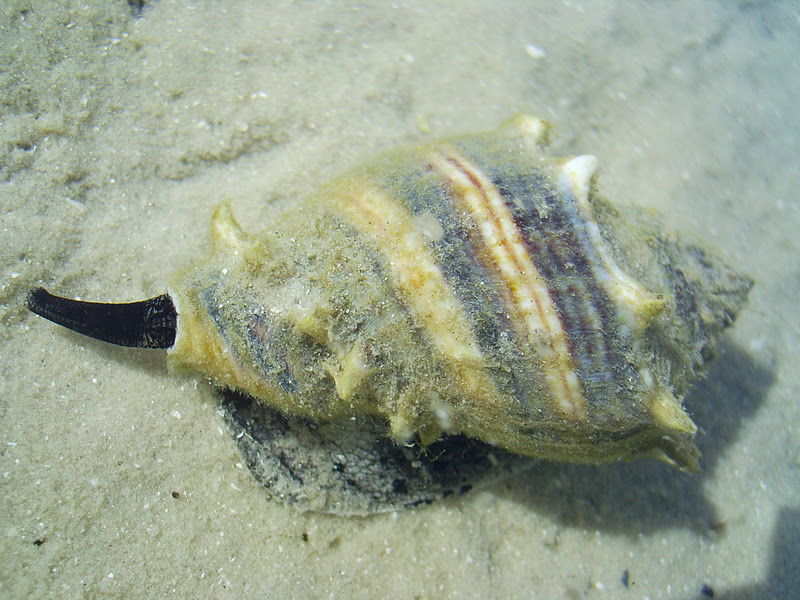
Seagrass and mudflat communities at low tide are an excellent opportunity for curious onlookers to explore and see up close the myriad of coastal life these dynamic environments can support. In particular, these environments harbor a high diversity of invertebrates (animals lacking backbones) from egg sack-producing  worms to predatory snails hunting in the mud for a snack. For those who aren't afraid to get a little wet and muddy, they won't be disappointed at what they can find. I thought I'd "wet" your appetite by starting you off with a quiz of some of the invertebrates you might discover in these communities. Good luck! (I've provided you with some clues to help name them.) Answers are on the bottom.

1. Hint: this is nether an equine's support apparatus nor a true crustacean as the name implies.

2. Hint: Perhaps not a pretty as the flower that shares its name, but cool nonetheless.

3. Hint: check out its royal head gear.
4. Hint: No spinning webs for this crustacean.

5. Hint: Don't let the electrifying streaks in the sky prevent you from naming this one.

6. Hint: Count the arms to help you with its name.

7. Hint. Think "fragile celestial body"

8. Hint: The mollusk has within its name, another word for swine.


ANSWERS
  1. Horseshoe Crab
  2. True Tulip Snail
  3. Crown Conch
  4. Spider Crab
  5. Lightning whelk
  6. 9-armed sea star
  7. Banded Brittle Star
  8. Quahog Clam

If you would like to learn more about these animals  and  other marine life that inhabit Florida's coastal waters, consider taking the Florida Master Natural Program Coastal Module. Details and Schedules and can found at: http://www.masternaturalist.ifas.ufl.edu/

Monday, November 28, 2011

Do You Know the Status of Red Tide in Your Area?

Recently there have been  reports of red tide events occuring near and offshore of Lee and Collier Counties. In Florida, a "red tide" generally refers to a bloom or rapid increase in the concentration of Karenia brevis cells, which is a marine algae species (specifically a dinoflagellate) commonly found in the Gulf of Mexico. K. brevis cells release a toxin that, in high concentrations, can be harmful to many types of marine life, and often result in  fish kills.
While red tide events naturally occur in the region, it is important for residents and visitors to stay informed about the status of theses episodes as they can have negative impacts on human health, local fisheries, and the coastal economy in general.
Fortunately, the FWC-Florida Fish and Wildlife Research Institute publishes a "Red Tide Current Status" page that provides a summary report of current red tide conditions around Florida. The site also includes a map of sampling results and regional status reports. You can sign up for weekly email updates via FWC's listserv by visiting: http://myfwc.com/research/about/information/subscription/ and following the directions. Reports are generally updated on Friday afternoon (except during holiday, in which case the report will be released on the closest day), and additional information, if available, is provided on Wednesday afternoons.

Tuesday, November 22, 2011

The Marine Scene Plus!

I'm pleased to announce a new resource for those of you who are interested in keeping up with marine events in Southwest Florida-The Marine Scene Plus. This new blog is a joint effort between Sea Grant Extension Agents, Libby Carnahan, John Stevely, Betty Staugler, Joy Hazell, and myself Bryan Fluech, The Blog is full of current marine-related events, program announcements, and interesting articles to make you a more informed coastal citizen. Besides following the blog, you can also elect to sign up for the Marine Scene eNewsletter that is published six times a year. Enjoy!


All entries are archived and searchable,
which makes it easier for your to find
 what you are looking for!